Middle School Python Pioneers in Coding
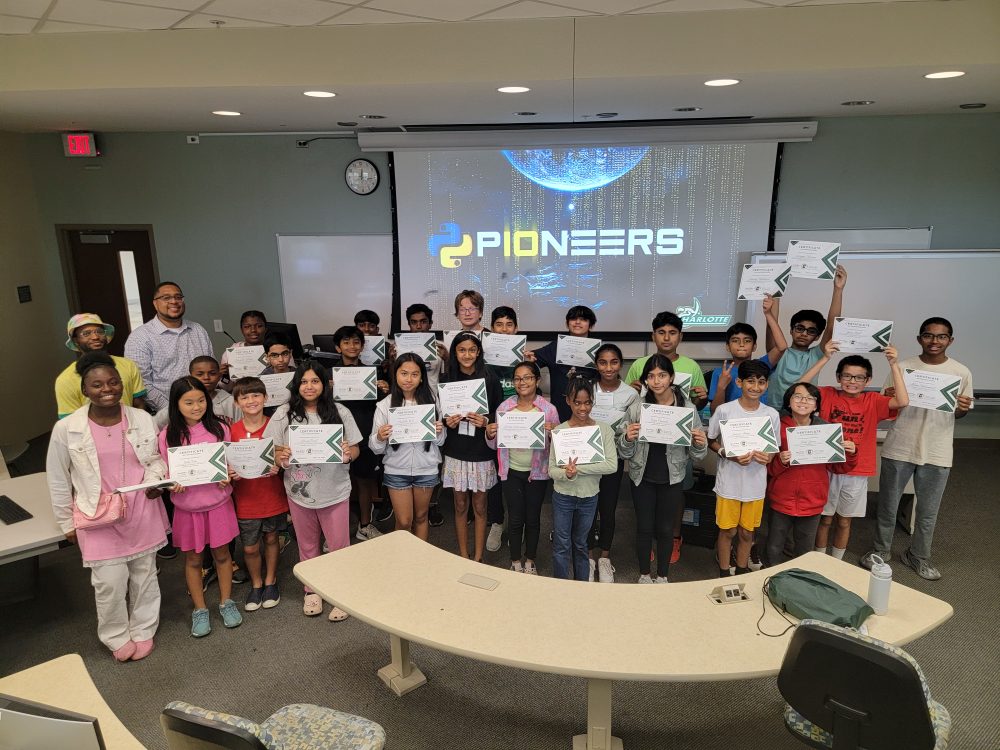
UNC Charlotte STEM Pre-College Program
July 6–10, 2026
Time: 9:00 a.m.–3:00 p.m. daily
Location: UNC Charlotte
Capacity: 40 students
Registration Fee: $250 for the week
Program Overview
Python Pioneers in Coding is a week-long, immersive STEM enrichment experience that introduces middle school students to computational thinking and the Python programming language. This program is designed for students with interest in coding and problem solving, and it emphasizes logical reasoning, algorithmic thinking, and real-world application of computer science concepts.
Mornings are focused on foundational lectures and guided instruction in Python syntax, programming constructs, and computational problem solving. Afternoons provide opportunities to apply learning through project-based coding challenges that build teamwork, creativity, and practical coding skills. Students will develop and debug Python programs, explore data manipulation, and create projects that address authentic problem scenarios.
This program is for enrichment only and is not intended as remedial instruction for students currently struggling in related academic areas.
Eligibility and Application Requirements
- Open to middle school students (typically grades 6–8)
- Interest in computer programming and computational problem solving
- To apply, families must:
- Complete the online application
- Submit the student’s most recent report card
- Pay the non-refundable registration fee of $250
Enrollment is limited to 40 students.
Daily Schedule
9:00–10:30 a.m. — Introduction to Python Concepts & Computational Thinking
10:30–10:45 a.m. — Break
10:45–12:00 p.m. — Guided Coding Labs & Practice
12:00–12:45 p.m. — Lunch
12:45–2:30 p.m. — Project-Based Coding Challenges
2:30–3:00 p.m. — Presentations, Reflection, and Debugging Tips
Weekly Themes and Sample Activities
Day 1 — Getting Started with Python
Theme: Introduction to Python, variables, data types, and simple input/output.
Activities:
- “Hello, Python!” basic script creation
- Interactive challenges with variables and print statements
- Computational thinking exercises: decomposition and pattern recognition
Standards Connection: Aligns with computational thinking practices and introductory coding constructs common to middle school computer science standards (e.g., algorithm design and programming fundamentals).
Day 2 — Control Structures and Logic
Theme: Conditional logic and decision structures.
Activities:
- If/else practice problems
- Building simple decision-making programs
- Debugging logic exercises
Standards Connection: Reinforces logical reasoning and flow control, foundational to middle school CS standards.
Day 3 — Loops, Functions, and Problem Solving
Theme: Iteration and modular code design.
Activities:
- While and for loop challenges
- Defining and calling functions
- Mini projects using loops and functions
Standards Connection: Supports modularity and structured programming principles within computational thinking.
Day 4 — Data Structures and Basic Data Processing
Theme: Lists, dictionaries, and working with data collections.
Activities:
- Building and manipulating lists and dictionaries
- Data exploration tasks using sample data sets
- Conditional aggregation and simple analytics
Standards Connection: Connects to data literacy fundamentals and structured data use.
Day 5 — Capstone Coding Project Showcase
Theme: Integrated application of coding skills to solve a creative or real-world problem.
Activities:
- Design, implement, and refine a capstone project using Python
- Peer code reviews and collaborative debugging
- Project presentations with explanation of computational strategies
Standards Connection: Emphasizes project-based application of computational thinking, teamwork, and communication.
Learning Outcomes
By the end of the week, students will:
- Demonstrate proficiency with basic Python programming constructs
- Apply computational thinking to problem solving
- Design, debug, and iterate on code independently and in teams
- Communicate algorithmic solutions effectively
- Build portfolio-ready coding projects