High School Forensics
UNC Charlotte STEM Pre-College Program
July 6–10, 2026
Time: 9:00 a.m.–4:00 p.m. (daily)
Location: UNC Charlotte
Capacity: 25 students
Registration Fee: $250 for the week
Program Overview
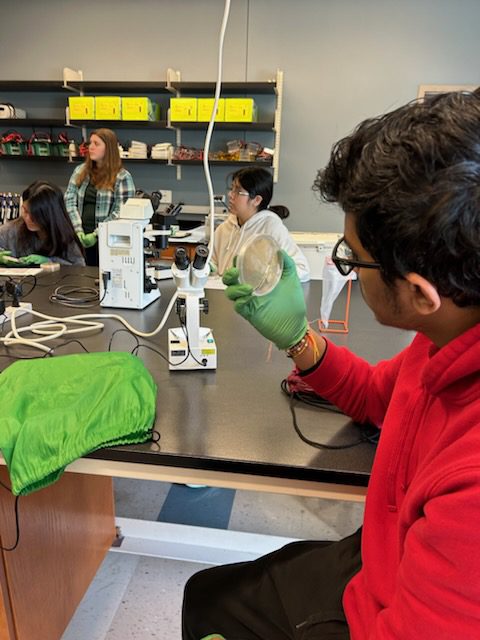
The High School Forensics program offers an immersive, week-long STEM enrichment experience that introduces high school students to the scientific methods and investigative techniques used in forensic science. Participants will explore how scientific principles from biology, chemistry, physics, and earth science are applied to analyze evidence, interpret scientific data, and solve simulated crime scenarios.
Mornings are dedicated to interactive lectures and demonstrations focused on core forensic science concepts, analytical strategies, and laboratory skills. Afternoons emphasize hands-on investigations and team-based problem solving where students apply what they’ve learned to realistic forensic challenges. Through these experiences, participants enhance their scientific reasoning, observational acuity, and collaborative skills in a supportive university environment.
This program is designed for enrichment and exploration; it is not intended as remedial instruction for students struggling in science coursework. Participation is ideal for students who enjoy applying science in investigative contexts and are considering future studies or careers in STEM fields.
Eligibility and Application Requirements
- Open to high school students (typically grades 9–12)
- Evidence of academic preparation or interest in science is encouraged
- To apply, families must:
- Complete the online application
- Submit the student’s most recent report card
- Pay the non-refundable registration fee of $250
Enrollment is limited to 25 students to ensure individualized attention and laboratory support.
Daily Schedule
9:00–10:30 a.m. — Lecture & Scientific Foundations
10:30–10:45 a.m. — Break
10:45–12:00 p.m. — Laboratory Skills Workshop / Evidence Techniques
12:00–1:00 p.m. — Lunch
1:00–3:30 p.m. — Team Investigations & Case Analysis
3:30–4:00 p.m. — Reflection & Debrief
Weekly Themes and Sample Activities
Day 1 — Crime Scene Essentials & Observation Skills
Theme: Introduction to forensic science, evidence types, and systematic observation.
Activities:
- Crime scene documentation and sketching
- Evidence categorization: testimonial vs. physical evidence
- Chain-of-custody simulations
Standards Connection: Applies scientific inquiry and data collection practices aligned with broad high school science expectations (e.g., designing investigations, analyzing data). (NC DPI)
Day 2 — Fingerprinting & Trace Evidence Analysis
Theme: Techniques for identifying and comparing physical evidence.
Activities:
- Fingerprint lifting and pattern classification
- Hair and fiber microscopy comparisons
- Soil and mineral profiling
Standards Connection: Integrates biology and earth science inquiry practices and crosscutting concepts such as patterns and structure-function relationships. (NC DPI)
Day 3 — Chemical Evidence & Toxicology
Theme: Chemical analysis of unknown substances and forensic toxicology fundamentals.
Activities:
- Chromatography experiments to separate mixtures
- pH, solubility, and reagent reactions for substance identification
- Introduction to toxicological screening methods
Standards Connection: Connects to physical science practices (matter and its interactions) and analytical reasoning. (NC DPI)
Day 4 — Molecular Evidence & DNA Profiling
Theme: Molecular methods for analyzing biological evidence.
Activities:
- Simulated DNA extraction and comparison activities
- Gel electrophoresis modeling with virtual tools or safe simulants
- Case studies on biological evidence interpretation
Standards Connection: Builds on biology laboratory practices (genetics and molecular evidence interpretation) and analytical data use. (NC DPI)
Day 5 — Integrated Forensic Case Challenge
Theme: Culminating team investigation integrating skills from the week.
Activities:
- Multi-evidence scenario requiring coordinated analysis
- Team presentations of findings and evidence-based conclusions
- Peer and instructor feedback session
Standards Connection: Reinforces scientific practices such as argumentation from evidence, modeling, and science communication. (NC DPI)
Program Benefits and Outcomes
Participants will:
- Practice scientific data collection, analysis, and interpretation across disciplines
- Gain hands-on experience with forensic techniques and laboratory procedures
- Develop critical thinking and collaborative problem-solving skills
- Communicate scientific findings effectively